Empowering Human Agility To Deliver Results With AI
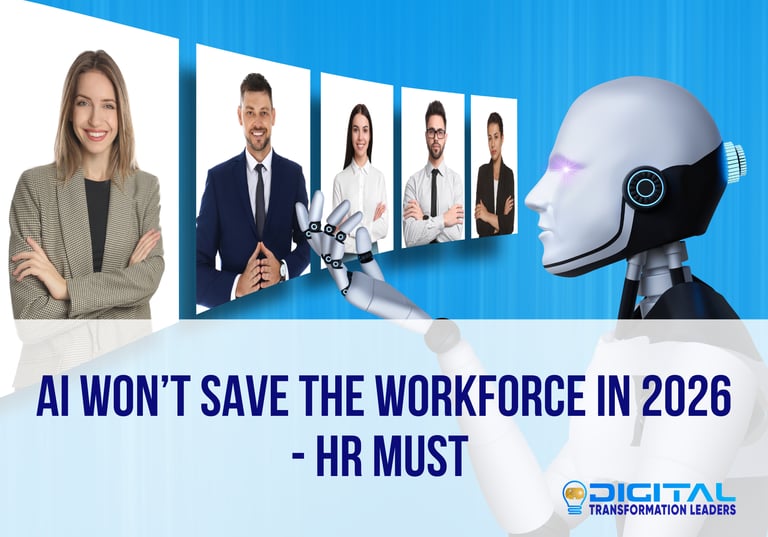
AI Won’t Save the Workforce in 2026 - HR Must
Technology alone is not enough. AI adoption is accelerating, but fear, skills gaps, and lack of agility are holding organizations back. In this article, I present: 1. The five workforce challenges HR must solve to unlock real AI value. 2. Why human transformation is the missing link for 2026. 3. How HR can empower employees to thrive with AI, innovate fearlessly, and drive real digital transformation and business ROI. Will HR rise to the transformation challenge of 2026?
M. Nadia Vincent
1/8/19253 min read
From AI Investment to Human Readiness
As we move into 2026, HR and People leaders are at the center of the most complex workforce transformation we have ever faced.
Digital transformation has reached a higher level. AI is no longer experimental. It is embedded across hiring, performance, operations, and decision-making. Yet despite heavy investment, many organizations are not seeing the expected productivity or innovation gains. The challenge is no longer access to technology. It is workforce readiness, adaptability, and trust.
For HR, Chief People Officers and similar roles, this is not simply a change-management issue. It is a human transformation mandate.
The Five Workforce Challenges HR Must Solve in 2026 to Maximize ROI from AI
AI adoption without human alignment Employees are expected to use AI tools without clarity on how they create value or how their roles evolve alongside them. This leads to surface-level adoption rather than meaningful impact.
Fear, anxiety, and disengagement Fear of job displacement and skill obsolescence remains one of the most powerful - and least addressed - barriers. When fear is present, people comply but do not innovate.
Skills gaps and role redesign pressure AI is redistributing work into human–AI collaboration. HR must support role redesign while ensuring employees feel capable, confident, and relevant.
Transformation fatigue Continuous organizational change without internal alignment creates exhaustion. People leaders are increasingly responsible for resilience, not just performance.
Workforce agility as a human capability Agility is no longer about processes alone. Learning velocity, adaptability, and openness to change are now core people capabilities.
Why Mindset and Brain Science Matter to HR Strategy
Brain science shows that fear keeps the brain in survival mode, limiting creativity, learning, and strategic thinking. When fear is reduced, the brain becomes more adaptive and capable of forming new neural pathways.
For HR leaders, this insight is critical:
Fear blocks AI adoption
Psychological safety enables learning
Confidence fuels innovation
Upskilling without addressing mindset and emotional readiness limits impact. Sustainable workforce transformation must address both the conscious and subconscious drivers of behavior.
The Missing Layer in Most People or Organizational Transformation Strategies
Most workforce initiatives focus on skills, tools, and processes. Very few address beliefs, identity shifts, and behavioral patterns, while they are the very elements that determine whether transformation succeeds or quietly stalls.
This is where HR’s role evolves: from capability builder to human transformation architect.
The Solution: "I Transform Me"
Our workforce transformation program “I Transform Me” is designed for the workforce, at various levels, navigating continuous change in 2026. It is a one-year, continuous transformation program built on a simple truth: people do not transform all at once, and neither should learning.
Through continuous learning, self-reprogramming, participants can focus on what matters most to them in the moment, from AI readiness, adaptability, leadership, innovation, to mindset transformation and more. Our continuous personal transformation approach supports alignment and sustained progress over time.
By combining upskilling with brain reprogramming, mindset, and behavioral transformation, “I Transform Me” helps individuals let go of fear, build confidence, become innovative and engage with AI as a partner rather than a threat.
From Fear to Human–AI Co-Creation
When employees feel safe and capable, AI shifts from being something to survive to something to create with.
Employees learn to:
collaborate with AI strategically
amplify creativity, judgment, and insight
create value instead of fearing replacement
This directly supports HR priorities around engagement, retention, and future readiness.
The Organizational Impact HR Leaders Care About
Organizations that support employee self-transformation experience:
stronger and more effective AI adoption
increased innovation and adaptability
reduced resistance to change
higher engagement and retention
more resilient, future-ready cultures
Instead of pushing adoption, HR enables readiness. Instead of managing fear, HR unlocks potential.
A Call to HR, Chief People & Chief Learning Officers
AI transformation will succeed or fail at the human level. HR leaders and organizations who will win in 2026 are those who go beyond skills training and invest in continuous, human-centered self-transformation, empowering employees to adapt, innovate, and create value with AI.
Our program ”I Transform Me” was designed for this moment: to support people as they evolve, and organizations as they transform continuously. Because when people transform, organizations thrive.
#AI #HR #workforce #digitaltransformation #chiefpeopleofficer #agileworkforce #individualtransformation #innovation #agility #Leadership #management #organizationaltransformation
I Transform Me
Embrace change and thrive in digital disruption.
© 2024 - 2026. All rights reserved. Digital Transformation Leaders